
About Lipo Sculpt
Non-surgical aesthetic, body contouring and wellbeing treatments, with individual consultation at the start.
Information before a decision

Lipo Sculpt offers treatment options for body contouring, skin concerns and intimate wellbeing. Its published approach begins with a consultation to understand the concern and consider suitability.
The aim of that discussion is to explore the available options, including their potential benefits, limitations and side effects. Individual results vary, and a treatment is not automatically appropriate for every person.
Use the services page as a starting point, then bring your questions to a consultation.
The customer charter
Lipo Sculpt’s About page sets out a customer charter centred on clear communication, respectful treatment, privacy and reliable information.
The charter also describes listening to feedback, addressing concerns and keeping customers informed about their suggestions or complaints. It places emphasis on explaining information in language customers can understand and helping them make informed choices.
These published commitments provide a useful starting point for a conversation about the care and communication you are looking for.
Areas you can explore
The official About page identifies cryolipolysis, HIFU, body sculpting, CryoPen, fat dissolving injections, incontinence treatment and vaginal tightening among the services offered.
The treatment overview groups information by concern. If you are unsure where to start, describe what you would like help with when you contact Lipo Sculpt.
Questions worth bringing with you
You do not need to turn your questions into a technical brief. A simple list can make it easier to compare the explanation you receive with what matters to you:
- What is the purpose of the suggested treatment?
- Why is it being considered for my concern?
- What are its limitations, and what would make it unsuitable?
- What preparation, recovery or aftercare should I discuss?
- What is included in the proposed cost?
- Who should I contact if I have a question afterwards?
Read the explanation at your own pace. If a term is unfamiliar, ask what it means. If the answer does not address your question, return to the specific point you need clarified.
Explore your next step
For practical consultation information, visit Book Consultation. For an enquiry about services or costs, use the contact page.
The privacy information and terms information provide routes to the full published policies. Keep those details alongside the treatment information when considering your next step.
Reading the customer charter in practice
The published customer charter is a useful reference when you want to understand how Lipo Sculpt describes its communication with customers. You can use it to frame specific questions about an enquiry or experience. For example, if an explanation is unclear, identify the term or part of the process you want explained again. If you are following up on feedback, say which point you are asking about and what answer would help.
A charter is different from an individual treatment plan. It describes a stated approach to service; it does not establish that a particular treatment is appropriate for you or promise a particular result. Keep those questions separate when speaking with the team so that a general description of customer care does not become a substitute for an explanation of your own proposed treatment.
Understanding the service information
The Services page provides the treatment overview for this website. When comparing options, start with the concern you want to discuss and then identify the relevant section. You do not need to decide between treatments from their names alone. Make a note of the description that interests you, together with anything it leaves unanswered.
Ask the person discussing your options to explain the purpose of a proposed treatment, the reasons for considering it and the information needed to assess suitability. Ask separately about possible limitations and the practical arrangements involved. A list of available services cannot answer those individual questions on its own.
Checking the details that matter to you
If the experience or qualifications of the person providing a treatment matter to your decision, ask who would be involved and what qualifications or training are relevant to that treatment. Ask for an explanation you can understand rather than relying on a general description of expertise. This page does not provide individual staff biographies or a list of verified qualifications.
The same approach applies to location and access. Ask which location or arrangement would apply to the treatment you are considering. If you need a particular accommodation, explain the need and ask whether it can be met before making arrangements. Do not infer practical details from an image or from a description of a different service.
Making feedback specific
When raising a question about your experience, describe what happened, when it happened and which part you would like addressed. Separate the facts of the interaction from the outcome you are requesting. Keeping those points together can help you express the issue clearly without having to repeat the whole conversation each time.
Use Contact Us to find the supplied telephone number and official enquiry destination. If the issue concerns personal information, consult the privacy information as well. If it concerns the conditions of an appointment, read the published terms and identify the particular provision you want clarified. No response deadline or complaints outcome is promised by this page.
A guide to the different areas of care

Lipo Sculpt's published service information covers several distinct concerns. It is useful to keep those concerns separate when exploring the website: a question about body shape is different from a question about a skin blemish, and an intimate-wellbeing enquiry may need a different discussion again. The names on a treatment menu give you a starting point for that discussion, rather than a conclusion about what you should choose.
The following guide helps you read the service categories and prepare questions relevant to each. It does not assign you to a treatment or compare the clinical effectiveness of different procedures. For the complete descriptions, follow the official references or use the treatment overview on this website. Where a question depends on your circumstances, bring it to the consultation rather than relying on a general category description. Keeping a clear distinction between information and an individual recommendation makes the website easier to use.
Exploring the body-contouring information
The official website includes a cryolipolysis information page. If this is the category that prompted your enquiry, identify the particular area or concern you want to discuss. Avoid using a broad phrase such as changing everything when a more specific description would help you understand whether the information addresses what you mean.
When reading the page, distinguish its general treatment description from the answer you need about your own situation. You might want to understand how a proposal would be assessed, what it would involve, which limitations apply and how any result would be reviewed. Record those as separate questions. A photograph or a treatment name cannot provide all those answers.
If you are comparing this category with another body-related service, use the same questions for both. That gives you a more useful comparison than relying on how confident or appealing one description sounds. Bring the comparison to the team and ask which distinctions matter for the concern you have described.
Reading about HIFU
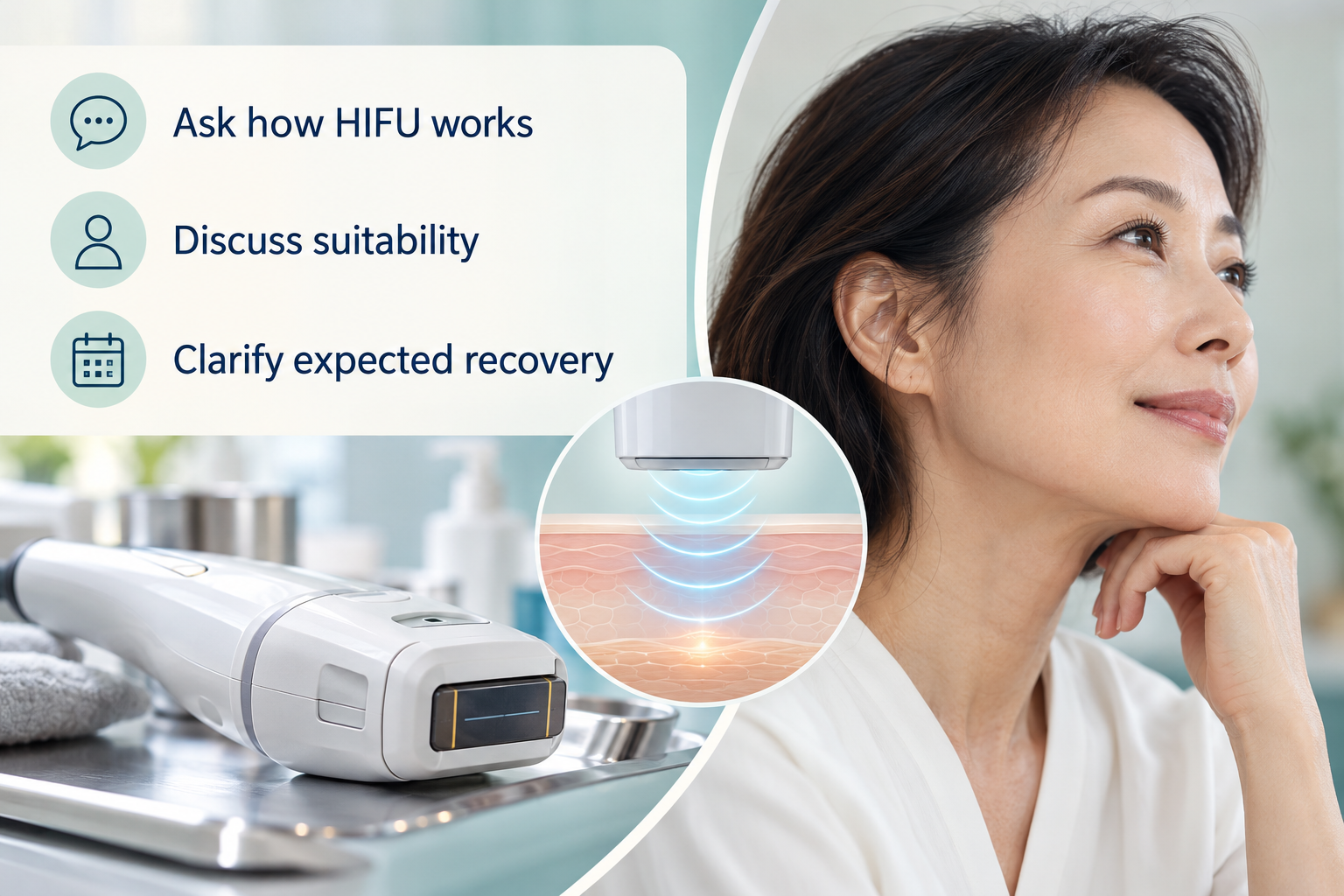
Lipo Sculpt publishes a dedicated HIFU page. Use it to identify the terminology being discussed before deciding which questions you want answered. If a description refers to several areas, be clear which area interests you so that a later conversation does not move between different proposals without your noticing.
A useful reading note has three parts: the treatment name, the part of the description relevant to your concern and the information you still need. For example, you may want the team to explain what a proposed session covers, how suitability is assessed or which practical arrangements would apply. Keep your question tied to the actual proposal rather than to a headline alone.
If an answer includes unfamiliar terminology, ask for a plain-language explanation and check that you have understood it. You can repeat the explanation in your own words and ask whether that accurately reflects what was said. This is a communication aid, not an assessment of whether HIFU is suitable for you.
Understanding the body-sculpting category
The official body-sculpting page uses the treatment name Tonesculpt. Treat that as a service label within the Lipo Sculpt offering. If you have encountered similar wording elsewhere, do not assume that the equipment, plan or arrangement being described is identical. Ask which specific option the team means when discussing a proposal.
For your enquiry, describe the issue you would like explained and the information you want before making a decision. You may want to discuss the intended purpose of the proposal, what would happen at an appointment and which limitations should be understood. If a course is mentioned, ask how the proposed course is structured and what its quoted cost includes.
Keep the treatment explanation and the booking conditions together when reviewing the answer. A clear understanding of the service is only part of deciding whether the proposed arrangement works for you. The dates, location, costs and applicable conditions should relate to the same proposal, rather than to examples from different pages.
Questions about fat-dissolving injections
The official website has a separate fat-dissolving injections page. If you are interested in that category, name it explicitly in your enquiry. Do not let a discussion about one option become an assumption that another option involves the same process. Ask for an explanation of the particular procedure being considered and the information needed to assess it.
Prepare questions about the proposed purpose, possible limitations, suitability discussion and practical arrangements. If you have read several descriptions, identify the one you are referring to so the team can address the same information. A question about a product name is different from a question about the person providing treatment or the conditions of an appointment; keep each clear.
This About page does not provide an injection protocol, personalised eligibility decision or predicted result. Its purpose is to help you find the correct service information and enter the conversation with a clear understanding of what remains to be explained. Any treatment decision should relate to your individual assessment and the specific proposal you receive.
Finding the skin-blemish information
The official CryoPen page is the reference for the skin-blemish service category. If you are looking at that information, explain what you would like assessed without trying to diagnose it from an image or a list of examples. A category heading helps you locate information; it does not establish the nature of a particular skin change.
Ask what assessment is needed before the team can discuss a treatment plan and how any requested information should be provided. If an image is requested, use the route specified by the service and ask about anything you do not understand. Avoid assuming that a photograph alone settles the question or that every example on a page applies to your situation.
For the practical side of an enquiry, identify whether your question concerns the consultation, the proposed treatment or the appointment arrangements. This helps you obtain an answer at the right stage. The treatment overview remains available for general orientation, while the consultation route is the place to clarify the next step for your own enquiry.
Approaching an incontinence enquiry
Lipo Sculpt's incontinence treatment page identifies an EM Chair service. If this is the subject you want to discuss, you can begin by naming the concern and asking how the consultation is arranged. You do not need to give a detailed personal account in a public comment to establish where to make an enquiry.
Think about what information would help you understand the process. You might want to know who will discuss the concern with you, what assessment information is needed, where a proposed appointment would take place or how a practical access question can be addressed. Those are distinct questions, and the answer to one should not be treated as an answer to all of them.
If a service description includes an outcome statement, ask how the relevant limitations and suitability considerations would be explained for you. This guide does not diagnose symptoms or recommend the EM Chair for an individual. Its role is to identify the official information and help you make a clear, appropriately directed enquiry.
Approaching an intimate-wellbeing enquiry
The official website also includes vaginal-tightening information. For a private concern, start with the contact route you are comfortable using and ask how the discussion will be handled. You can request an explanation of the consultation process before deciding how much detail to provide at that stage.
Use your own words to describe the question. If a treatment term is unfamiliar, ask what it means in the context of the proposed service. Keep questions about comfort, assessment, risks and practical arrangements separate so that none is lost inside a general answer. Where you need clarification, return to the particular point rather than assuming the website has already answered it.
This section does not infer a medical condition from the reason for your enquiry or state that a treatment is appropriate. It helps you identify the relevant source and prepare for a conversation. Any explanation you receive should address the concern you have actually described, including the points you need resolved before considering a next step.
Bringing several concerns into one discussion
If more than one service category interests you, write each concern on a separate line. Then identify which concern matters most to your decision. This gives the conversation an order without assuming that every concern should lead to a treatment or that several treatments should be arranged together.
Ask the team to distinguish the purpose of each proposed option. If two options appear to address similar concerns, ask what difference is relevant to your situation. If the discussion introduces a combination, ask which part of the explanation and cost relates to each element. Keep the proposals separate in your notes until the relationship between them is clear.
A useful record should allow you to explain the proposal back in ordinary language. If you cannot tell which treatment is intended to address which concern, that is a specific point to clarify before proceeding. This approach helps you review the information without turning a long list of service names into a decision you have not yet made.
Distinguishing a description from a promise
Website information can help you recognise a topic and decide which questions to ask. It does not supply all the details of a personal arrangement. When reading a statement about a service, consider whether it describes the category generally, gives an example or relates to a proposal made specifically to you. Keep those forms of information distinct in your notes.
For example, an image may illustrate the subject of a page without showing the result you can expect. A general explanation of a process may not specify your session length or the number of appointments under discussion. If one of those details affects your decision, ask for an answer about your own proposal rather than filling the gap yourself.
You can still use the website constructively: identify the statement you want explained, keep the page address and bring a focused question to the team. That produces a clearer discussion than assuming that every general statement is a personalised commitment.
Looking for a complete explanation
A complete explanation should make it possible for you to identify the proposal and the questions still open. You can organise your notes under purpose, process, limitations, practical arrangements and costs. These headings are a reading aid, not a description of a mandatory Lipo Sculpt consultation format.
Under purpose, record the concern the proposal is intended to address. Under process, record what the team says would happen. Under limitations, note the issues you have asked about and any points requiring further assessment. Practical arrangements can cover the location and proposed dates, while costs can identify the amount and what it includes.
After the conversation, look for missing connections between the headings. For example, a cost may be clear while the number of sessions it covers remains uncertain. A proposed date may be discussed before the location is settled. Identifying that particular gap allows you to ask a short, useful follow-up instead of restarting the entire enquiry.
Comparing information without losing context
If you read several pages over time, record which page each note came from. Similar treatment names or general descriptions can otherwise become mixed together. Keep a distinction between material published on the website, information given during your enquiry and a written proposal relating to you.
When two pieces of information seem different, ask about the difference. It may concern a different service, a different arrangement or a question that has not yet been resolved. This guide does not decide which explanation applies; it helps you identify the discrepancy precisely enough to discuss it.
Avoid comparing only the shortest headline or the largest claimed benefit. Use the questions relevant to your decision, such as the proposed purpose, limitations, location and total arrangement. If one explanation leaves a point unanswered, mark it as unanswered rather than assuming that it matches the answer on another page. An honest comparison can include gaps that still need clarification.
Making communication easier to follow
Choose a small number of priority questions for the beginning of a conversation. You can keep additional questions in your notes and return to them after the central issue is clear. If an answer is long, ask the person speaking to identify the main point and the next step. This can help you distinguish background explanation from an action you are being asked to take.
If you prefer to review an explanation in writing, ask what written information is available. If you need a term explained differently, identify the word rather than saying that the whole subject is confusing. Those requests give the team something specific to respond to.
You can also check your understanding by summarising what you think was agreed. Include any uncertainty in that summary. Saying that a date was discussed but not yet confirmed, for example, preserves the distinction that matters when you later review the conversation. The aim is a record you can understand without relying on memory alone.
Keeping the person's own priorities central

An enquiry may begin with something you have noticed, a treatment description you have read or a practical question about arranging care. Write down which of those prompted you to make contact. This helps you recognise whether a later explanation addresses the reason you started the enquiry.
If another person is helping you explore the website, discuss which questions you want them to raise and which you would prefer to ask yourself. Their support does not need to determine the treatment you consider or the information you choose to share. Ask the team how to arrange a conversation involving someone else if that would be helpful.
If your priorities change after reading more, make that clear in a follow-up. A new concern may require a different explanation from the one already discussed. Updating the question is more useful than trying to fit a changed priority into an earlier proposal that no longer addresses what you want to understand.
Reviewing an experience after an interaction
After contacting the team, consider whether the explanation answered the questions you actually asked. You can review that without having decided to proceed. Note which information was clear, which point remains open and whether an action was agreed. Keep those observations separate from a prediction about what might happen next.
If you want to give feedback, refer to the interaction and the effect it had on your understanding. For example, you might explain that two descriptions of a payment left you unsure which amount was due. Asking for that specific issue to be addressed gives the feedback a practical purpose.
The published customer charter provides the background for Lipo Sculpt's stated service approach. Your feedback can identify how an individual interaction relates to the clarity or communication you were seeking. This page does not prescribe an outcome for a complaint or promise a response within an invented time limit.
How the pages on this website fit together
Use Home for the overall introduction and Services for the treatment overview. This About page adds context for understanding the service categories and the published customer-care approach. Contact Us provides the supplied contact routes and enquiry guidance. Book Consultation explains the official onward route and offers a preparation guide for that conversation.
The privacy and terms pages address different questions. Privacy information helps you find the published policy and frame questions about information you provide. Terms information helps you locate the official booking conditions and identify points requiring clarification. Neither should be inferred from a treatment description alone.
You can move between these pages as your question becomes more specific. Start with the information relevant to the decision you are considering, then use the official contact or consultation route when an answer depends on your circumstances. There is no need to treat reading the website as a commitment to a service or as confirmation that an appointment has been arranged.
Understanding who handles each stage
An enquiry may involve questions about several stages: obtaining general information, discussing an individual proposal and arranging an appointment. Ask which person or contact route handles the stage you are currently discussing. Knowing that distinction can help you direct a question accurately without assuming that one conversation settles every part of the process.
If you are referred to another person, ask what information you need to repeat and how the next conversation is arranged. Keep a short note of the referral and the question that remains open. If you want another person to participate in the discussion, ask how that involvement should be agreed rather than assuming information will be shared automatically.
This is particularly useful when a practical question and a treatment question arise together. You can identify which answer concerns the arrangement and which requires an individual assessment. The website provides routes into that conversation; the team can clarify who is responsible for the particular next step being proposed.
Further information: official Lipo Sculpt our approach page.